|

MoPac's first
125 Years
The citizens had turned out
en masse to take part in the ground-breaking celebration for the start
of construction of the Pacific Railroad, the first railroad west of the
Mississippi River. From that humble beginning grew the vast network of
rail lines that nurtured the great west and southwest, and from which
eventually came the Missouri Pacific Railroad of today.
Looking back, it was the discovery
of gold in California in 1848 that brought forcibly to the attention of
the American people the urgent need for more rapid and dependable transportation
facilities in the West.
Missouri and the West needed
railroads, and St. Louisans visualized a railroad all the way to the Pacific
Ocean and wanted very much for that railroad to start from their city.
Leaders of St. Louis secured a Missouri charter in 1849 for the "Pacific
Railroad" to extend "from St. Louis to the western boundary of Missouri
and thence to the Pacific Ocean"
That year, however, turned
out to be a very hard one for St. Louis. Early in the year a cholera epidemic
struck. Another disaster occurred when fire, which broke out on a river
steamboat, spread and destroyed twenty-two other boats, and a considerable
part of the business district. With the heart of its business destroyed
by fire and almost a tenth of its inhabitants dead of cholera, the city
exhibited an ominous picture of early death and financial ruin.
So it was not surprising that
the 1849 railroad plans were delayed. However, in spite of the cholera
and the fire, optimism prevailed, and on January 31, 1850, a preliminary
organization was formed and stock subscription lists were opened. James
H. Lucas offered to be one of three to make up $100,000, a large sum for
those days. John O'Fallon and Daniel D. Page promptively joined Lucas.
A coin was- flipped to see which of the three would take the odd thousand
dollars and O'Fallon won the toss. Like other early subscribers those
men acted in the public interest rather than in expectation of any early
direct return on their investments.
The temporary organization
was succeeded by a permanent one, with Thomas Allen as president. The
country was canvassed for the most competent engineer, and the choice
fell on James P. Kirkwood, who had constructed some of the early Massachusetts
railroads and had also been in charge of operation of the New York and
Erie.
So little was then known of
much of central Missouri that Kirkwood's civil engineers surveyed five
possible routes to enable a proper choice of the best one. While these
surveys were in progress, efforts were continued to secure aid from Congress.
But Congress denied aid for the Missouri project.
This setback only increased
the determination of the Missouri people. State aid was sought and secured
and efforts to sell stock increased. As part of these attempts to get
the railroad actually underway, theground breaking celebration was
held on the Fourth of July, 1851.
Under the direction of Chief
Engineer Kirkwood, purchases of land were begun and grading started. Because
the route selected required the construction of two tunnels west of what
became Kirkwood, and because tunnel excavation was necessarily slower,
work on these tunnels was also begun at that time.
Rails were purchased in England
and were shipped to New Orleans for transfer to St. Louis by river steamboats.
Locomotives and cars came the same way. The first locomotive was the "Pacific,'
which also bore the number "3" It was made at Taunton, Massachusetts,
and was unloaded on the river wharf on August 20, 1852. With its driving
wheels five feet in diameter, the engine weighed 29,000 lbs. and cost
the company $7,650.00.
Ocean and river freight costs
amounted to another $1,000, and a local contractor charged $200 to haul
it 14 blocks over the city streets from the wharf to the railroad depot.
The passenger cars which arrived shortly thereafter, seated 60 persons
and cost $2,300 each, f.o.b. Troy, N.Y. They were not considered satisfactory,
however, and the Pacific Railroad soon began to build its own cars.
On December 9, 1852, a passenger
train, with the company's officers and leading citizens of St. Louis aboard,
inaugurated the new Pacific Railroad with a trip to the end of the line.
The people of Missouri then had their first look at a steam railroad.
That train was the first to be operated west of the Mississippi River,
and ran the five miles from the depot on Fourteenth Street to Cheltenham
in some ten minutes.
By July 1853 work on the two
tunnels west of Kirkwood was completed so that the "First Division" of
the railroad could be opened. This division extended 38 miles to Franklin,
now Pacific, Mo. The train to make that trip was pulled by a locomotive
made in the new St. Louis locomotive plant of Palm & Robertson.
But with financial difficulties
now slowing progress, it took nineteen months before the next eighteen
miles (to Washington, Mo.) were completed. And Missouri's capitol city
was still another seventy miles away.
The Pacific Railroad reached
Jefferson City late in 1855. West from that point the railroad was purposely
located away from the Missouri River for fear that it would be unable
to compete with the steamboats. However, the Pacific Railroad itself established
a fleet of twelve steamboats to connect with the trains at Jefferson City
and transport passengers and freight on up the river to Kansas City and
beyond. An advertisement of that period stated that at Jefferson City
passengers could step from the train to the waiting steamboat and that
by this route, the time from St. Louis to Kansas City had been cut to
only 50 hours!
While the Pacific Railroad
was thus being started, other Missouri railroad projects were being fostered.
These were the St. Louis & Iron Mountain, the Cairo & Fulton,
the Southwest Branch of the Pacific Railroad, the North Missouri, and
the Hannibal & St. Joseph.
The Iron Mountain was begun
at St. Louis in 1853. An early obstacle that had to be overcome by the
railroad's builders was the requirement of the U.S. War Department that
Iron Mountain trains had to be pulled by horses or mules through the government
property at the St. Louis Arsenal, the U.S. Marine Hospital and at Jefferson
Barracks to avoid the hazard of fire from sparks from the woodbuming locomotives.
It took congressional action to overcome this handicap.
Texas also was engaged in building
railroads before the Civil War. Some of these early railroads are now
in the Missouri Pacific family. One was Houston's first railroad, the
Houston Tap. It was placed in service in 1856.
Another early Texas railroad
was the Galveston, Houston & Henderson, chartered in 1853. Construction
was started in 1856, and WI en it was finished it was the first railroad
touching the Texas Gulf Coast.
The Texas Western Railroad,
chartered in 1852 to build from the eastern to the western boundary of
the state, later became the Texas & Pacific. Several other pre-Civil
War railroads became parts of today's Missouri Pacific Railroad.
Meanwhile, work on the Iron
Mountain had continued southward from St. Louis and by May, 1857, the
800-ft.-long tunnel at Vineland had been completed along with a bridge
over the Meramec River. DeSoto, Mo., was reached in September, but the
event escaped mention in the newspapers, probably because there was no
DeSoto until after the railroad came.
Since the original impetus
behind construction of the Iron Mountain railroad had been the desire
to reach the iron ore and other mineral deposits thought to abound in
the Ozark foothills south of St. Louis, an all-out effort was being made
to complete the 84.5 miles to Pilot Knob as quickly as possible. Despite
unfavorable weather and shaky finances, this was accomplished on April
2,1857
By July, 1858 the Pacific Railroad
was completed the 160 miles to Tipton, Mo., then the end of the line from
St. Louis. Tipton was also the eastern terminus for a new overland mail
service to San Francisco. This service, called "The Overland Mail', made
its initial eastward stagecoach run from San Francisco on September 16,
1858, arriving at Tipton on October 10. At Tipton, the mail and passengers
were transferred to a waiting Pacific Railroad special train for the run
to St. Louis. The time from San Francisco to St. Louis was 24 days, 18
hours and 26 minutes, about 10 days faster than the old Isthmus of Panama
route.
During the Civil War, raids
were made against all of the Missouri railroads and great damage was done.
The most serious one on the Pacific was that led by Sterling Price in
the fall of 1864. Bridges, buildings, tracks and rolling stock were destroyed
all the way from Franklin to Kansas City. Early in 1864, rails, locomotives
and cars had been taken by Missouri River steamboats to Kansas City and
construction eastward from that point started. The line from Kansas City
to Independence (Kansas City's first railroad) had been opened to the
public on August 1, 1864, but even this disconnected section did not escape
Price's fury.
Repairs to the damaged property
were ultimately completed and the railroad resumed construction. On September
19, 1865, the last spike was driven connecting the two parts of the railroad,
and the next day a train was run through from Kansas City to St. Louis,
leaving at 3:00 a.m. and arriving in St. Louis at 5:00 p.m.
With the end of the War, new
construction and extension of the other Missouri and Texas railroads was
resumed and 1873 saw a large amount of railroad building going on. In
that year, the Texas & Pacific extended from Marshall to Texarkana
and also into Dallas. The International and Great Northern was completed
to Longview where connection was made with the Texas & Pacific. The
Cairo & Fulton built through Arkansas southward into Texarkana, a
move that had been delayed by the Civil War. This line had to link up
with the Iron Mountain to provide through service from St. Louis to Texas.
To speed construction and get
into operation as quickly as possible, bridges over the White, the Arkansas
and the Red rivers were passed up for the time being and passengers and
freight were transferred by ferry until the bridges could be constructed.
But the all-important thing was that the service was in operation by 1874.
The new lines provided all-rail routes between St. Louis, Dallas and Houston,
and through Pullman cars soon ran.
In 1868 the Eads Bridge over
the Mississippi River was started at St. Louis, thus beginning what Kirkwood
had thought impossible, a railroad bridge over the Mississippi River.
To permit the free interchange of cars with those eastern railroads which
had standard gauge and which expected to use the new bridge, in 1869 the
Pacific Railroad changed its original " wide gauge" track to standard
gauge. The change was also of advantage at Kansas City where the Pacific
connected with the newly started Kansas Pacific, which later became the
Union Pacific. The completion of Eads Bridge in 1874 extended the new
standard gauge track through St. Louis to the Atlantic states.
It was also in 1874 that the
Union Depot Company in St. Louis was incorporated. It then built a station
that served the railroads until 1894, when the present Union Station at
18th and Market Sts. was opened.
Meanwhile, financial difficulties
in 1872 forced the reorganization of the Pacific Railroad, and when it
emerged from receivership it had a new name: the Missouri Pacific Railway
Co.
About 1873 a New York financier,
Jay Gould, became interested in western railroads when he acquired a large
block of stock in the Union Pacific Railroad. Subsequently, he purchased
control of the Kansas Pacific, the Denver Pacific and the Central Pacific.
Gould noted the westward expansion policy of the new Missouri Pacific
Railway as a threat to his Union Pacific, and in 1879 he bought a controlling
interest in the company and became its president.
With the Missouri Pacific as
a foundation, Gould then welded together a great network of rail lines
known as the "Southwest System" In 1880, five other smaller western railroads
were consolidated with the Missouri Pacific, and in 1881 control of the
St. Louis, Iron Mountain & Southern was acquired. In 1880 Gould gained
control of the Texas & Pacific, and then had his Missouri Pacific
lease the Missouri, Kansas & Texas system. Gould also purchased control
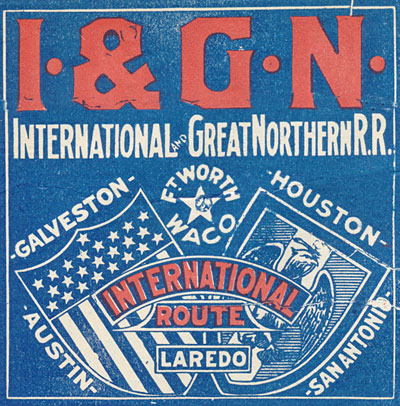
of the International Great Northern and completed the line of this latter
railroad into Laredo, Texas.
Hub of the I-GN, which was
built from Longview and Fort Worth to San Antonio and Houston in the late
'70s and early '80s, is Palestine, for it is where one stem breaks off
to San Antonio and Laredo and the other angles southward to Houston and
Galveston.
But Gould was unable long to
retain control of his vast rail empire. In 1885 the management of the
Texas & Pacific was separated from that of the Missouri Pacific, and
in 1888 the lease of the Katy railroad properties was terminated, a move
which divorced the I-GN from Missouri Pacific control. Of all the lines
which Gould had joined to the Missouri Pacific only the Iron Mountain
remained at the end of 1888.
Between 1885 and 1892, however,
there was a large increase of Missouri Pacific mileage through construction
of subsidiary lines. Extensions were built through Kansas and Colorado
to Pueblo, western terminus of the Missouri Pacific system, while the
Iron Mountain's southern line was completed into Alexandria, Louisiana.
Activity
in new railroad building and extension of existing trackage was practically
stopped by the 1892 depression, but between then and 1910 major projects
completed included the Illinois Division, the lines from Helena, Ark.,
south to Ferriday, La., the White River line from Carthage, Mo., to Batesville,
Ark., and the River Route between Jefferson City and Boonville, Mo. Certain
branch lines in Arkansas and Louisiana were purchased.
It was also during this period
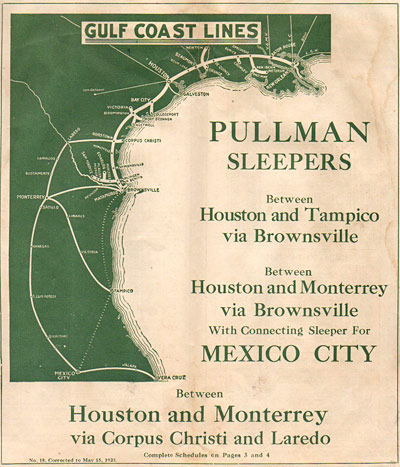
that the main stem of what later became the Gulf Coast Lines was constructed.
This extended from Anchorage, opposite Baton Rouge, La., through Houston
to Brownsville, Texas. Work was started on the Brownsville end in 1903
and the Baton Rouge end was finished in 1909. At the time of their construction,
these lines were subsidiaries of the Frisco. The latter suffered a receivership
in 1913 as one result of which it lost the Gulf Coast properties. In 1916
they were sold to the New Orleans, Texas & Mexico Railway, and operated
as the Gulf Coast Lines.
In 1909 many smaller subsidiaries
were formally merged with the parent Missouri Pacific Railway, and in
March, 1917, a final merger of the Missouri Pacific Railway and the St.
Louis, Iron Mountain & Southern (Iron Mountain) was completed
and a new company was formed - the Missouri Pacific Railroad Company.
Lewis W. Baldwin became president
of the company in April 1923 and the acquisition of the Gulf Coast
Lines and the International _Great Northern was an early project of his
regime. Later, the San Antonio, Uvalde & Gulf was acquired to round
out the system in southwest Texas. These properties serving Texas and
Louisiana were formally merged in 1925 with the Missouri Pacific Railroad.
In May, 1928, Missouri Pacific
occupied its new 22 story general office building in downtown St. Louis
and continued the task of amalgamating its merged properties into a smooth
running and efficiently functioning system. The "Missouri Pacific Lines"
became the familiar name in the company's public image.
But unfortunate financial conditions
developed in 1933, and the company was placed in the hands of a Trustee,
with Mr. Baldwin as chief executive officer. However, physical improvements
of the properties and diversification of its services were encouraged
by the Federal Court. Thus, in April, 1938, the Missouri Pacific Freight
Transport Company was organized as a subsidiary of the railroad. Its truck
routes were not to be in competition with the railroad, but would supplement
them.
In 1937 the first diesel locomotives
made their appearance on Missouri Pacific tracks. These early switch engines
were followed by passenger locomotives which powered the company's first
lightweight, streamlined train, the "Missouri River Eagle", placed in
service in 1940. By 1955 all steam locomotives had been retired from service
and soon all were scrapped.
Centralized traffic control,
to expedite the movement of trains, was extended to include much more
trackage after World War 11, and radio communications equipment became
standard on all the company's locomotives. A long-range program of installing
radio in wayside stations to maintain contact with trains on the line
was begun in that period.
Under war-time restriction
in 1942, the "Colorado Eagles,' St. Louis to Denver diesel-powered passenger
trains, replaced the Scenic Limited on June 21. Within four years these
Eagles had run 2,616,904 miles and had carried 2,062,000 passengers.
With the death of Mr. Baldwin
in 1946, Paul J. Neff, then senior executive assistant in charge of the
lines in Texas, became chief executive officer under the Trustee. Numerous
plans for reorganization of the properties under the Trusteeship were
advanced from time to time, but one after the other failed to meet the
approval of the various parties of interest. Nevertheless, under the Trusteeship,
the railroad continued to improve and modernize its properties and it
kept pace with the changing patterns of rail transportation.
In 1946 work began on an extensive
grade and line revision project on the Missouri Division, some 140 miles
south of St. Louis, in the Granite Bend, Tip Top, Gad's Hill area. More
than 24,000 feet of track were involved in the initial phases of the project
including blasting out cuts 47 feet deep through rock harder than granite.
This was part of a long-range program to improve that part of the mainline
to Texas to provide higher speed track for the advent of the Texas Eagle
streamliners. Those trains replaced the famed Sunshine Special and made
their inaugural runs on August 15, 1948.
In June, 1950, the Settegast
Yard was opened at Houston. Its tracks covered 375 acres. A flat switching
yard, Settegast fulfilled a need for expanded facilities to service the
fast-growing Texas Gulf Coast petrochemical industry.
After two years in the building,
the Miller Street Freight Station in St. Louis opened January 2, 1952.
Occupying more than five acres, the huge building had space for 180 freight
cars under one roof.
During Paul Neff's tenure in
office, piggyback freight traffic gained impetus in American railroading
and under his direction Missouri Pacific developed a specialized method
of handling this type of business. It featured the use of demountable
containers in truck-rail service, the trailer bodies being lifted off
their wheels by gantry cranes and deposited onto flatcars for rail transport
to destination. This service was inaugurated early in 1956.
Meanwhile, railroad financial
circles had been stirred in 1954 when another attempt was made to take
Missouri Pacific out of bankruptcy. After months of negotiations to seek
a new plan of reorganization, a formula was finally devised which proved
satisfactory to all concerned. But it was not until two years later, on
March 1, 1956, that the United States District Court at St. Louis officially
ended Missouri Pacific's 23 years of receivership.
Mr. Neff was elected president
of the new Missouri Pacific, but a year later-in May, 1957-he relinquished
the presidency and was named chairman of the board. He served until his
death one month later.
Russel L. Dearmont, for 20
years counsel for the Trustee, was elected president to succeed Mr. Neff.
He had entered service of the Missouri Pacific as a district attorney
at Cape Girardeau, Mo., in 1930 and was appointed counsel for the Trustee
in 1936.
The reorganized Missouri Pacific
which Mr. Dearmont now headed continued to progress, with the railroad
making an all-out bid to regain freight traffic lost to over-the-highway
truck lines. The company also increased its efforts to attract new industries
to its 12-state territory. To further one such enterprise in 1958, some
$3 million was spent to build a 27-mile spur to service a new iron ore
mine operation set up near Sullivan, Mo.
Modernization of the properties
continued uninterruptedly, and in November, 1959 a $13-million double-crest
automatic freight car classification yard was opened for service in Kansas
City, Mo. Two years in building, it embodied the latest advances in electronic
technology. The Kansas City and proved so successful that similar, single-crest
classification yard was built in North Little Rock, Ark., and went in
service March, 1961.
In this same period developments
in the field of electronic data processing found increased railroad applications
and the company soon acquired its first computers and the complex array
of component equipment.
The company's initials-MP-continued
as symbols of the Modern and Progressive spirit of Missouri Pacific's
heritage. Electronic data processing was expanded; many miles of continuous
welded rail were laid; an entirely new and automated wheel shop at North
Little Rock was underway in 1963 and the first completely automated railroad
freight station in the nation was placed in operation at St. Louis in
1963.
In the two-year period, 1962-1963,
more than $100,000,000 was spent to improve the equipment, track and structures
of the system. Included were 3,217 new freight cars and 156 new locomotives.
Through intensive repairs, the railroad's serviceable cars were increased
to more than 97 per cent of its 57,577-car fleet.
To effect economies in operation
and eliminate costly duplicate facilities, a consolidation of the operations
of the majority-owned Texas & Pacific Railway subsidiary into the
Missouri Pacific lines was being effected in 1963.
And so ... as it entered its
113th year of service to the public, the Missouri Pacific - Texas &
Pacific System, with its 12,000 miles of railroad in twelve states, had
become a dominant force in the transportation services available to the
dynamic west-southwest territory it helped to build. The strategic geographical
position of the System afforded connections with all major rail lines
that extended to the four corners of the nation and into Canada and Mexico.
An 'important factor in Mo-Pac's
recent history has been the Mississippi River Corp., a holding company
which also controls subsidiaries involved in the production and transmission
of natural gas as well as cement manufacturing. Mississippi began buying
Mo-Pac stock in 1959 and gained voting control in 1962. Mississippi Board
Chairman William G. Marbury's candidate to succeed Russell L. Dearmont
as president of Mo-Pac was Downing B. Jenks. Mr. Jenks was elected president,
and Mr. Dearmont was elected chairman of the board, in 1961. Mr. Jenks
came to the Mo-Pac from the Rock Island Lines where his election as president
in 1956 at age 40 made him the youngest president in modern railroad industry.
Beginning in 1961, Mr. Jenks
initiated an intensified plant and equipment modernization program that
continues today. He also immediately began building a new management team.
An important factor in developing the new team was the lowering of Mo-Pac's
retirement age from 70 to 65 which made it possible both. to promote people
already with the railroad and to make room for personnel brought in from
outside.
One Mr. Jenks brought in 1961
was John H. Lloyd. Mr. Lloyd joined Mo-Pac as vice president-operation,
the same post he had held with the Rock Island Lines. In 1971, Mr. Jenks
was elected Mo-Pac chairman and the same year was elected president and
chief executive officer of Mississippi River Corp. following the death
of Mr. Marbury. Mr. Jenks was elected chairman of the board of Mississippi
in 1973. Mr. Lloyd succeeded Mr. Jenks as president of the Missouri Pacific
in 1972 and was elected chief executive officer of Mo-Pac in 1974.
During
Mr. Jenks' presidency. Mo-Pac made major strides in improving the efficiency
of its operations through mergers and acquisitions. In 1964, Mo-Pac's
Texas and Pacific Railway subsidiary assumed control through stock purchase
of three railroads making up the 767-mile Muskogee Co. system which operated
in Oklahoma, Kansas, Arkansas and Texas.
The T&P retained control
of the 203-mile Kansas, Oklahoma & Gulf, and of the 335-mile Midland
Valley Railroad. These railroads crossed at Muskogee, Okla., and through
a connection at Okay, Okla., had direct "cut-across" access to lines into
Wichita and Kansas City. The T&P sold the third line -the 104-mile
Oklahoma City-Ada-Atoka Railway-to the Atchison, Topeka and Santa
Fe Railway.
The acquisition provided Mo-Pac
a direct route between Kansas City and the Southwest by way of Oklahoma
-a route 319 miles shorter than the previous one. The Midland Valley and
the KO&G subsequently were merged into the T&P in
1967 and 1970, respectively.
A threat to the efficiency
of traffic handling at the important St. Louis gateway developed in 1966
when the Cotton Belt, a Southern Pacific subsidiary, attempted to monopolize
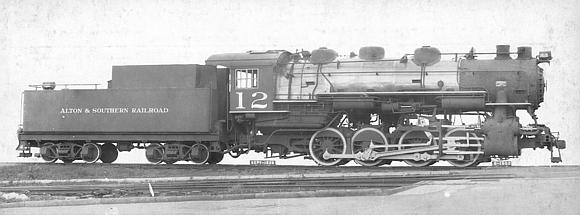
the Alton & Southern Railroad, a vital terminal switching facility.
Mo-Pac filed an application with the Interstate Commerce Commission to
acquire the A&S, proposing that its ownership would be joint with
other line-haul carriers so that this terminal facility would continue
to be open to all railroads. After hearings were completed, the ICC in
1968 authorized Mo-Pac and the Chicago & North Western Railroad to
purchase the A&S. Today, the East St. Louis terminal and classification
yard of the Alton & Southern, now owned jointly by the Missouri Pacific
and Cotton Belt, continue to play a major role in moving rail traffic
through the St. Louis gateway, classifying freight for Mo-Pac and nine
other railroads.
 |
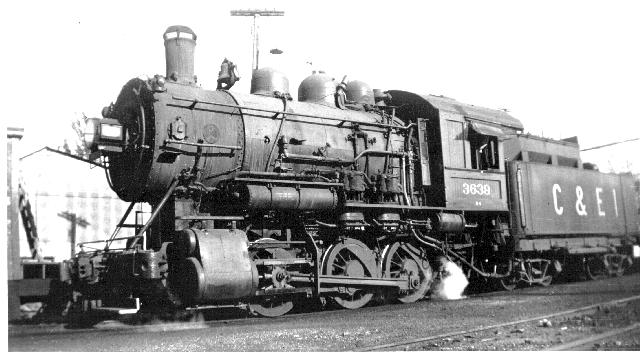
Looking north from St. Louis,
Mo-Pac had long recognized that the Chicago & Eastern Illinois Railroad
represented a natural extension of its routes into Chicago, the nation's
largest rail gateway and the primary gateway for traffic moving between
the U.S. and Canada. Mo-Pac began acquiring C&EI stock in 1961. The
Louisville & Nashville Railroad also sought control of the C&EI.
Mo-Pac immediately applied to the Commission for authorization to control
the C&EI, which was granted in 1967. However, the ICC required that
the C&EI sell its Evansville line to the L&N. This sale, finalized
in 1969, gave the L&N joint ownership and common usage of C&EI's
Chicago to Woodland Junction Line and outright ownership from Woodland
Junction south through Danville, Ill., to Evansville, Ind.
Mo-Pac's acquisition of the
C&EI made possible a direct service over the Missouri Pacific System
between Chicago and the West and Southwest, bypassing the busy St. Louis
gateway via Thebes in southern Illinois. in addition, via the C&EI's
western leg, Mo-Pac now had a line to provide direct service between the
important Chicago and St. Louis gateways.
As soon as it gained control
of the C&EI in 1967, Mo-Pac began to rebuild the railroad and bring
it up to the modern standards of the rest of the Mo-Pac System. This included
construction of new shops, expansion of yards, replacement of lightweight
track with continuous welded rail, installation of Centralized Traffic
Control, rebuilding of bridges and purchases of new freight cars and locomotives.
In 1974, with this rebuilding job largely accomplished, Mo-Pac introduced
its North American Rail Link, which provides single-carrier service across
the United States between Canada and Mexico. Mo-Pac has the only single
system route linking Chicago and Laredo, Texas, the foremost rail gateways
to our neighboring countries. MoPac has actively promoted this new route
and is moving an increasing amount of traffic as trade among the U.S..,
Canada and Mexico continues to grow.
Growth by merger was on Mo-Pac's
mind early in 1966 when it began buying shares of Santa Fe Railway preferred
stock. In May of the same year, Mo-Pac and the Mississippi River Corp.
filed a joint application with the Interstate Commerce Commission for
authority to acquire control of the Santa Fe. These actions were based
on Missouri Pacific's belief that the natural and logical development
in the realignment of the railroad industry west of Chicago and the Mississippi
River would include the amalgamation of the Santa Fe and Mo-Pac.
In 1968, Mo-Pac and the Mississippi
River Corp. withdrew their joint application, partly because of the complex
nature of Mo-Pac's dual stock structure which had led to litigation between
the two classes of Missouri Pacific stockholders. The unsuccessful attempt
to merge with the Santa Fe and other merger proposals which had either
been rejected or not seriously pursued because of Mo-Pac's capital structure
pointed to the need for MRC, which controlled Mo-Pac's Class A stock,
and Alleghany Corp., which controlled the Class B stock, to resolve their
long-standing differences.
Alleghany Corp., a New York
based holding company, once controlled the Missouri Pacific and when the
railroad emerged from reorganization in 1956, Allegheny's common stock
holdings were transformed into Class B shares. As the majority owner of
Class B stock, Alleghany had, in effect, a veto power over mergers or
other major moves affecting the railroad's capitalization since a majority
vote of each class of common' stock - B as well as A - was needed for
approval. In 1967, a holder of Mo-Pac Class B shares sued the railroad
over its dividend policy. Alleghany Corp. joined the suit the next year.
Before the issue came to trial,
the parties agreed on a recapitalization plan late in 1972 which was approved
by the court early the next year. Completion of the recapitalization of
the Missouri Pacific was accomplished early in 1974. Specifically, the
recapitalization involved issuing one share of $5 Cumulative Convertible
Preferred Stock for each share of previously outstanding Class A Common
Stock and the issuance of 16 shares of Common Stock, plus $850 in cash,
for each share of previously outstanding Class B stock. The recapitalization,
which resolved the stock conflict and provided an essential stock restructuring,
also gave Mo-Pac the potential for more active participation in the Western
Railroad merger movement and cleared the way for the Missouri Pacific
to proceed with its own corporate unification.
Thus in 1974, Mo-Pac was enabled
to take a further step toward corporate simplification: the merger of
The Texas & Pacific Railway as well as the Chicago & Eastern Illinois
Railroad into the Missouri Pacific to create a system unified in name
as well as in fact.
The merger plan was drafted
and subsequently was approved by stockholders of the three companies at
separate meetings in October, 1974. Application was made to the Interstate
Commerce Commission which authorized the merger in May, 1976, Mo-Pac's
125th anniversary year. However, the merger was delayed by parties seeking
reconsideration of the Commission's order.
 On
October 15, 1976, merger of the T&P and the C&EI into the Missouri
Pacific Railroad was consummated under the ICC's original order when the
Fifth Court of Appeals in New Orleans denied a request to stay the effectiveness
of that order. The unified system - a goal of Mo-Pac people for decades
was accomplished.
Hundreds of miles of conventional
rail have been replaced by continuous welded rail; many bridges have been
rebuilt or upgraded; millions of dollars have been invested in new terminals
to handle piggyback and small shipments and still more millions in automated
freight classification yards.
Thousands of new freight cars
and hundreds of locomotives have been added to the Mo-Pac System freight
fleet, which ranks as one of the best-maintained and youngest fleets in
the rail industry. Shops have been built new or modernized and highly
sophisticated computer, communications and signal installations have been
made across the railroad. Mo-Pac also has had success in refining its
services and in developing marketing concepts that have enhanced the company's
competitive position.
Efficient movement of freight
depends in part on Mo-Pac's locomotive and freight car repair and service
facilities, among the most complete and modern in the industry.
The railroad's largest maintenance
center for locomotives and cars is at North Little Rock where an automated
wheel shop and airbrake shop were built in 1964. Other installations there
have included a rail welding plant, producing quarter-mile lengths of
continuous welded rail for the entire system, that was completed in 1967,
and a diesel locomotive repair and overhaul complex which began operation
in 1969. North Little Rock also is the location of the railroad system
headquarters for distribution of materials and supplies.
A multi-stage modernization
program carried out at Mo-Pac's major freight car repair complex at DeSoto,
Mo., was completed in 1966 with construction of a car fabricating shop,
the seventh new structure built during the project. Additional freight
fleet service facilities built new or expanded in this period included
the installations at Wichita; Omaha; San Antonio', Ft. Worth, Laredo and
Marshall, Texas, and Avondale, La.
Heavy investment also has been
made since 1961 at key freight yards throughout the Mo-Pac System to streamline
traffic movements. The railroad's multi-million dollar automated classification
yard at North Little Rock, which went into operation in 1961, was first
expanded in 1962, again in 1964 when eight classification tracks were
added to make a total of 64, and again in 1966 when a special adjoining
city freight yard was built. Yard capacity was doubled at San Antonio
in 1964 and late in 1967 Mo-Pac announced a massive project for Lancaster
Yard at Ft. Worth.
The three-year Ft. Worth project
involved both expanding the yard's capacity and converting it to automated,
electronic operation. The task was especially difficult because the old
yard was kept operating while the new one was built on top of it.
Completed in 1971 and named
Centennial Yard in honor of The Texas and Pacific Railway's 100th year,
the new 44-track classification yard is one of the most modern in the
nation.
Mo-Pac's heavy investment in
shops and yards has been matched with both investment and innovations
in service to improve the railroad's competitive position. Since the early
Sixties, the Missouri Pacific has steadily increased its traffic share
of such major commodities as chemicals, automobiles and auto parts, wheat
and other food grains, lumber and paper products, steel, iron ore, sand
and gravel, and coal.
Coal was the first commodity
Mo-Pac hauled in unit train service, a field the railroad entered in 1966.
This is the movement of great tonnage's of single bulk products between
two points on a regularly scheduled basis. Now grain and ore, as well
as coal, move in Mo-Pac unit trains.
For the automobile industry,
Mo-Pac also operates special trains that carry parts to assembly plants
and move finished vehicles to unloading/distribution facilities at strategic
trackside locations. Missouri Pacific's auto distribution center at Arlington,
Texas, was doubled in size in 1967. New centers were built at Lee's Summit,
Mo., and St. Louis in 1973.
Cooperative service arrangements
with other railroads have been, and continue to be used when they can
improve equipment utilization and upgrade _ transportation service. Such
operations include run-through trains with pooled locomotive of Mo-Pac
and other roads and coordinated transcontinental service for which the
Missouri Pacific joins with one or more other rail carriers to provide
streamlined transportation.
An important part of Missouri
transportation service is transportation consultation, provided to customers
by Mo-Pac sales representatives. Recognizing the importance of its sales
representatives, Mo-Pac established an in-depth sales training program
in 1970. This program, one of the first in the railroad industry, has
been expanded and upgraded since. Another training program for Mo-Pac
personnel features regular lessons on such topics as ICC law, international
and government traffic, freight claims and pricing regulations.
Perhaps the most dramatic development
in Missouri Pacific service since 1961 has been what Mo-Pac calls "total
transportation" Mo-Pac has made steady progress toward its goal: operation
as a total transportation company using all transport modes to offer all
the combinations of service that a shipper may need. A consistent industry
leader each year in both growth and volume of piggyback and containerized
traffic, Mo-Pac has invested heavily-more than $20 million since 1961
in the facilities and hardware needed to efficiently handle intermodal
movements.
Freight terminals, piggyback
facilities and track-rail installations were either built new or greatly
improved and expanded throughout the Sixties at San Antonio, Dallas, Houston,
New Orleans, North Little Rock, St. Louis and Kansas City. More recently,
all-new intermodal distribution centers have been built at St. Louis,
Memphis, Ft. Worth, Monroe, La.,and Wichita.
A key factor in Mo-Pac's intermodal
performance has been the operations of the railroad's two motor carrier
subsidiaries: Texas and Pacific Motor Transport Co., and Missouri Pacific
Truck Lines, Inc., established in 1929 and 1938, respectively.
These subsidiaries have become
a major trucking system, operating more than 3,100 units of equipment
over 18,000 miles of highway routes in Missouri Pacific's mid-America
territory.
Limited by law for several
years to handling less-than-carload traffic in railsubstitute service,
Mo-Pac's truck lines achieved a major breakthrough in 1975 when they were
granted authorization to handle interstate traffic on their own, instead
of railroad, billing, Missouri Pacific's trucking subsidiaries have played
an important role in Mo-Pac total transportation operations, both performing
on their own and assisting the railroad to perform several intermodal
operations and services.
One such intermodal service
-Piggyback-received substantial upgrading beginning in 1964 with the introduction
of the first of a seriesof special piggyback trains to provide highway
competitive service between Chicago and St. Louis and key Texas cities.
Another transport mode water
was added to Mo-Pac's total transportation arsenal in 1969 with the establishment
of Missouri Pacific Intermodal Transport, Inc., a non-vessel operator
that handles the details of ocean freight forwarding for international
shippers. In 1970, Missouri Pacific introduced Containerpak, a series
of shipping plans that organized movements by container. Mo-Pac pioneered
the use of containers in 1928 and remains a leader in containerization
with one of the industry's most extensive line-ups of container handling
facilities and services.
An important intermodal step
toward total transportation was made in 1972 when Missouri Pacific Airfreight,
Inc. began operations in St. Louis. Mo-Pac Airfreight, with operations
bases at several key cities, takes advantage of Missouri Pacific's terminals
and the trucks of the railroad's two motor carrier subsidiaries to offer
shippers expedited forwarding of air cargo to and from all major airport
cities in the U.S., and to points in Canada and Mexico.
Making airfreight and the other
elements of total transportation work together has required prompt adoption
of new technology, particularly in the areas of traffic control, communications
and computer applications. In 1966, Mo-Pac was the first in the industry
to install a solid-state Centralized Traffic Control machine. Another
first was Missouri Pacific's introduction the same year of a fully-automated
materials management system providing computer determination of reorder
points and quantities, automatic Surplus checking, purchase order writing
and automatic vendor selection. Mo-Pac's computer applications have since
expanded into the areas of traffic and market analyses, equipment control,
car accounting and car tracing.
But Mo-Pac's most ambitious
application of computer technology to date has been its Transportation
Control System (TCS), a computer-based management information and control
system that actually exceeds in scope and complexity the Apollo Moon Program
used to launch, guide and land the astronauts. TCS, whose implementation
began in 1969, is helping Mo-Pac to keep an incredibly tight rein on the
railroad, to provide pin-point control of 400 trains moving 70,000 cars
every day over Missouri Pacific's 12-state, 12,000-mile system. This program's
goals are more efficient and reliable freight transportation/distribution
service, maximum utilization of Mo-Pac equipment, reduced paperwork and
better communication with customers.
In 1975, the Federal Railroad
Administration awarded Mo-Pac a $5.5 million contract to develop an automated
freight car scheduling system, built upon the data base and operating
applications of Missouri Pacific's TCS.
Announcing the contract, Federal
Railroad Administrator Asaph H. Hall noted Mo-Pac's progress in transportation
control via TCS. He said, "This is a laudable pioneering effort by the
Missouri Pacific and it is one which other railroads may utilize to improve
the reliability of the transportation product, the utilization of the
freight car fleet and the communication with customers"
The FRA also noted that while
some other railroads had spent as much as Mo-Pac in the area of movement
control, only the Missouri Pacific had accomplished all of the steps essential
as a working foundation for precise scheduling of individual freight cars,
loaded and empty, dock-to-dock.
|